Suscríbete a Gobe Insights
Recibe conocimiento clave para liderar la innovación pública y transformación govtech.
¡Apúntate!Button Text



Why this wave of AI will reshape the government?
Governments are information-processing machines, and AI is ready to transform them
I have never been particularly excited by technology. I watched previous waves (the internet, blockchain, big data, platforms, the metaverse…) as a curious but fairly passive spectator. Yes, I’ve written a PhD on data governance and my work is squarely focused on how governments can use data, technologies, and innovation. But my interest has always been in the government side, not the tech tools.
I am convinced that governments have a central role in making our societies better places to live, and have thought deeply about how the government “machinery” can be designed, redesigned and put to work to keep that promise. Technology is just one tool to achieve that goal, but one that puts the state’s strengths and weaknesses to the test. That is what made tech interesting.
Now it’s more than just “interesting”.
With the current evolution of AI, that tension, with its risks and promises, is of a different order of magnitude, and depth. Previous technologies changed government, but this one is going to reshape it.
Here’s why I think this time is different.
Governments are, at their core, information processing machines. They gather data - about people, events and things-, analyze it, reason over it, make decisions based on that analysis, and generate outputs. Most of this information is unstructured data (data that cannot be reduced to numbers in rows and cells, basically): conversations, images, petitions, claims, decisions, speeches…
The latest generation of AI technologies, with their ability to analyze vast amounts of unstructured (and structured) data, set up plans, use digital tools, and work autonomously and persistently to achieve established goals, hits exactly at the type of work that governments are set out to do.
I find it useful to think about the impact of this transformation at three levels:
At the “micro” level of public employees’ tasks, AI already does two things much faster and, often, better. First, it can search and extract information from unstructured data more widely and systematically. For example, given access to it, an AI can collect all the regulations in a city, all the recordings of interactions with citizens from a service, the specifications of existing permitting tools and supporting infrastructure, or all the medical records of millions of patients. Second, it can analyze that information and produce outputs in the form of rules, guides, communications, tenders, code, or permits. These two tasks alone are what public employees - and knowledge workers for that matter - spend most of their days on. We all have experienced, with different degrees of awe, how a chat window was able to do, in minutes, what used to take us hours, when not days.
We can call this “cognitive work”.
Increasingly, AI agents can do “cognitive work” on their own. They are not just tools that we humans use, but they can do some of these tasks independently and persistently. They can, for example, conduct daily searches and produce reports ready for decision making. Or they can interact directly with citizens, informing them about public services and sometimes make decisions for them. Here the AI doesn’t just augment a human task, but replaces it completely. And in the process, it collects, registers and documents data in massive amounts. Data that AIs then go on to process. If I were a startup selling this idea, I would call it the agentic infinite feedback loop (or flywheel?).
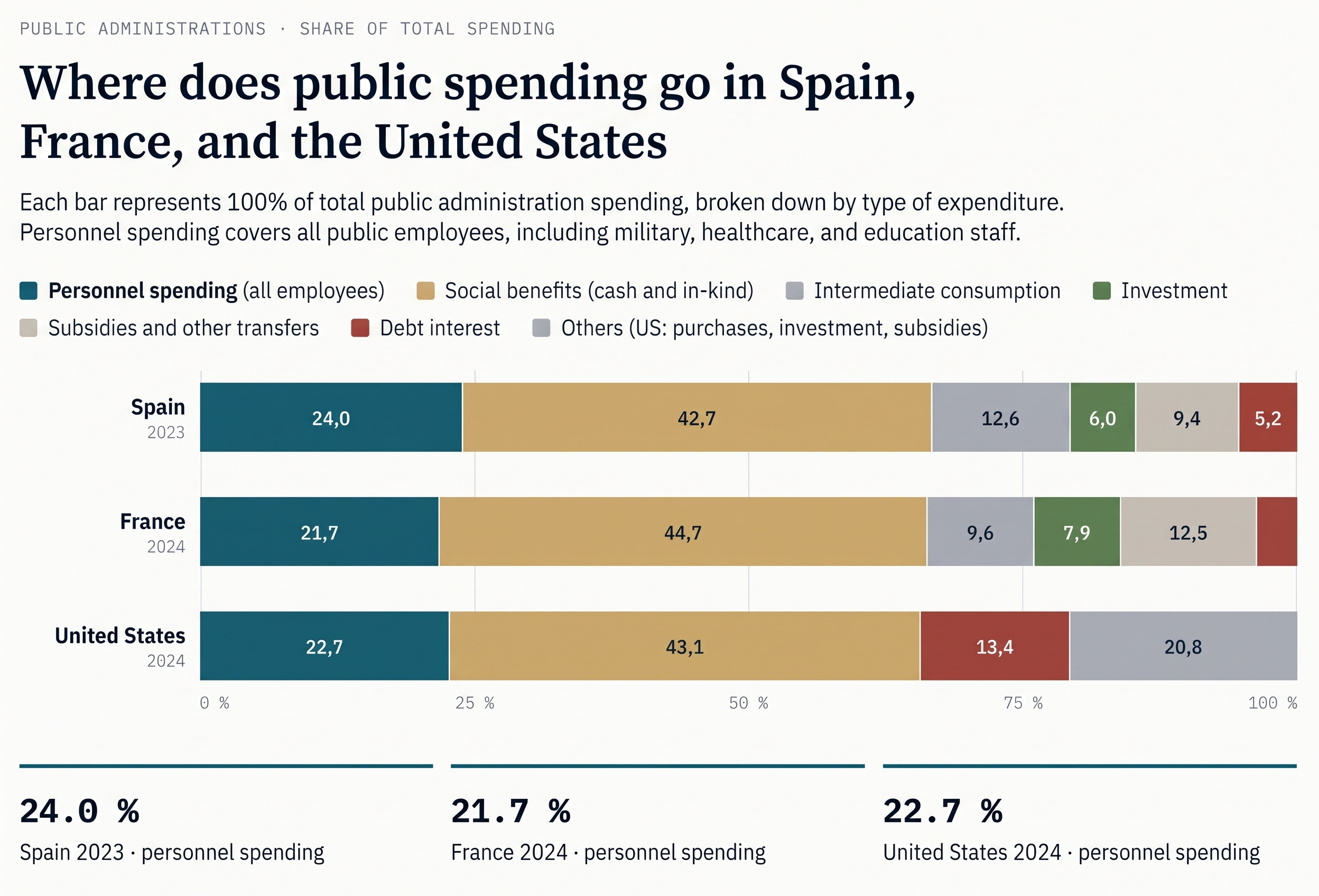
Another way to gauge the impact of AI on government is to look at (the “macro level” of) government spending. Employee payroll in countries like the US, France and Spain is the second largest spending category, after social benefits.1 Not all the people included in this category does “cognitive work” as their main task, of course. Think of police or military officers. Yet, when not patrolling the streets or in the field, even they are processing information (analyzing or reading reports, searching for evidence, communicating online…). Included in the other categories of government spending are also items, such as consulting work outsourced to companies, that could easily count as “cognitive work”.
Created with Claude Opus 5.5
The point here is not to read these numbers directly as “work AI will transform”. What they show is how much of government spending is made by these tasks that are now being augmented, but also replaced, by generative and agentic AI tools.
There is a third level, the organization, that will also be transformed by AI, but here change slows down. There is no shortage of debate on whether AI will flatten organizations, its likely impact on middle-managers, and what it will do to junior and entry level positions, including interesting reports by the big AI labs themselves. I am particularly intrigued by ideas and frameworks on the different shapes that organizations with combined workforces of AI agents and humans will take.
These shifts will also come for government structures, but I am less clear about how exactly. They will also take longer than changes at the task level. Organizations are hard to change. They are not just a collection of people, or of tasks done by people. They have written and unwritten rules that encode incentives, beliefs and values. These rules also distribute power among members and groups within the organization. Changing values and power allocation is not something an AI will do directly. Its adoption will, but much more slowly and in ways that are harder to anticipate.
Government organizations are also particularly rigid. Rules around how people are hired, rewarded and assigned roles, how funding is allocated across tasks and functions, and how money is ultimately spent are expressly designed for stability and predictability. They will, therefore, slow down how transformations at the task level translate into changes at the organizational one. And they will also slow down adoption at the task level, by the way.
This, for me, is the strongest argument against my thesis, and the best case that this time may not be so different after all.
Seeing what I see today and knowing what I know today, however, I expect this technology to fundamentally reshape governments. When we look back in 10-20 years, and compare the government institutions of 2040 with those of today, I think we will be struck by how far (hopefully for the better) we have come.
I am looking forward to being part of that journey, working with others excited by the mission of improving how governments contribute to richer, happier and fairer societies. That also means hearing and reflecting deeply on the perspectives of those who do not share my premise, either because they are skeptical about the technology and its potential, or because they fear that its impacts will just leave us worse off. I am, personally, very happy to be convinced otherwise. So wherever you stand, if you have thoughts, ideas, good references, or projects on this, I would love to hear from you and find ways to collaborate.
1 Payroll is compensation of employees, meaning gross wages plus employer social contributions for all general government staff, including the armed forces, public hospitals and public education. Pensions paid to retired civil servants are counted as social benefits, not payroll. Shares are of total consolidated general government expenditure across central, regional/state, local and social security levels (total non-financial expenditure for Spain), and refer to Spain 2023 (provisional - IGAE), France 2024 (provisional - INSEE) and the US 2024 (BEA, NIPA). Figures are not fully comparable.
* Guest contributor: Fernando Fernandez-Monge. Senior Associate at the Bloomberg-Harvard City Leadership Initiative at Harvard University and researcher at the Institute for Innovation and Public Purpose at University College London.