Suscríbete a Gobe Insights
Recibe conocimiento clave para liderar la innovación pública y transformación govtech.
¡Apúntate!Button Text



The Public Sector Path: How Three Digital Startups and SMEs Successfully Scaled
What separates a GovTech pilot that remains a photo op from one that leaves a lasting impact? We break down the journeys of Woza Labs, eAgora, and RateNow: three companies that successfully deployed digital solutions across the public sector.
In the world of GovTech, there are no shortcuts or silver bullets. There are pilots, key learnings, and strategic decisions that separate a nice photo op from a project that truly gains traction—marking the line between an innovative idea that fizzles out and one that blazes a new trail.
Woza Labs, eAgora, and RateNow demonstrate this through three distinct lenses:
- Woza Labs pivoted from an unscaled pilot to building a geospatial model in the Basque Country that is now a global benchmark.
- eAgora turned a single municipal trial into a region-wide implementation across an entire Autonomous Community.
- RateNow made real-time quality feedback in hundreds of hospitals and airports its gateway into nationwide local government markets.
Three stories, three distinct strategies and teams, stretching from Biscay to Tarragona, that nevertheless share core common denominators.
These are startups and digital SMEs that didn't find instant success, but recognized that scaling isn't a linear journey; it demands continuous learning and adaptation. Their leaders understood when to take bold bets: proposing to build the ultimate geospatial model, taking on a challenge in a much larger municipality, or engineering a straightforward tool built to replicate seamlessly.
Above all, these niche tech companies found forward-thinking public sector teams and institutions willing to trust and invest in them.
In a sector where results take time and lessons accumulate slowly, these stories offer valuable blueprints for anyone looking to scale solutions and drive public sector impact.
1. Woza Labs
From an Unscaled Pilot to a Benchmark Geospatial Model
Insights from Sebastián Priolo, Co-founder and CEO.
Founded in 2021 and based in Bilbao, Woza Labs is a deep-tech startup. Originally focused on building "tech engines"—reusable software infrastructure to accelerate startups in risk, climate, and sustainability—it evolved into developing proprietary solutions in specific verticals for enterprise and government clients.
A striking detail in their journey? Their first public sector pilot didn't scale at the time, falling short of the company's initial expectations. But in hindsight, that turned out to be a blessing in disguise.
Woza Labs operates across energy, food, fintech, and agriculture, collaborating with enterprise clients and tech giants like Iberdrola, Moeve, SIMA Earth, Google, IBM, and Microsoft. Its core product lines focus on climate risk, agroforestry, and Earth dynamics (parametric coverages).
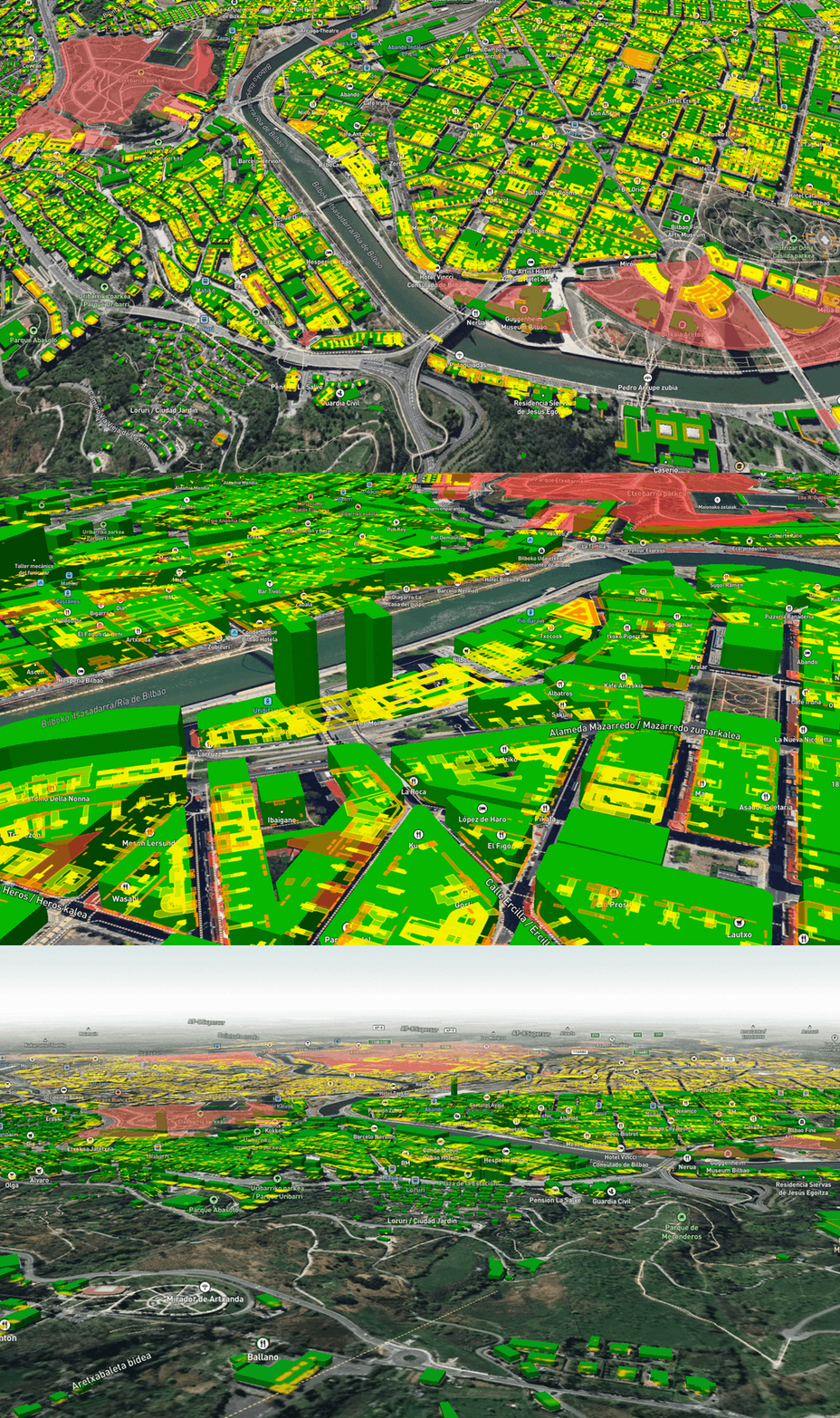
The startup shifted from a purely B2B mindset to collaborating with public institutions and becoming a benchmark for public-private partnership. This shift was catalyzed by their participation in the first cohort of the Gobe Ventures Accelerator and a challenge with the Basque Energy Agency (EVE) under the 2023 BIND GovTech program.
The lessons learned from that initial challenge informed future innovations and paved the way for a large-scale project with HAZI, another Basque public agency, to develop a forest geospatial model that is now considered a global reference point.
Woza Labs secured a HAZI public tender thanks to its growing public sector expertise and advances in geospatial modeling. Partnering with a highly knowledgeable public team, Woza proposed an ambitious goal: build "the ultimate forestry digital twin." Although still under development, the project has already been highlighted by Google as an exemplar of geospatial innovation—earning the startup an invitation to speak at the 2025 Geo for Good Summit in New York.
“Instead of doing something off-the-shelf, we asked: why not aim to build the best forestry digital twin out there?”
Essentially, we enable a government entity to map everything happening on the ground with absolute precision. In this case, that means mapping literally every single tree in the Basque Country—tracking what happened to it, what is happening to it, and what will happen to it in the future," explains Sebastián.
Woza Labs' evolution is remarkable—especially considering that the founding team came from LATAM and the US, where working with the government seemed out of the question. "Government wasn't even on our radar; it was a taboo topic," he recalls. Today, the public sector is precisely where they innovate and scale.
Learning by Doing (and From What Fails)
Woza Labs was one of six startups selected for the inaugural BIND GovTech cohort. Its pilot with EVE aimed to build a predictive model for emissions to optimize traffic and environmental impact across the Basque Country.
The pilot provided real-world insight into how public institutions manage and use data, which helped Woza refine its internal processes, strategy, and engineering methodologies.
"We faced a massive data challenge," Sebastián recalls. Discrepancies emerged between datasets from the regional Basque government, the provincial authority, Google, and Waze. "None of them correlated," he notes. To solve this, they conducted ground-level measurements, combining live camera feeds with Google Traffic data to develop a model that coordinates traffic flow and optimizes carbon emissions.
After the pilot wrapped up, Woza Labs spent a year iterating internally on these takeaways, evolving the platform into the model now recognized globally.
Woza Labs' Key Takeaways for Scalable Innovation
- Technical infrastructure awareness: Public institutions must understand the engineering infrastructure required for the project, mapping out requirements at a technical level, not just functionally.
- Staffing and cross-departmental coordination: Identifying assigned personnel and involved departments early on—assessing data-sharing readiness and communication channels—smoothes pilot execution and signals institutional long-term commitment.
- Clear success criteria: Define success metrics up front and establish whether meeting them triggers project continuation. Crucially, accept that higher levels of innovation entail greater uncertainty and risk of failure.
- Positive externalities and learning: Map out secondary benefits, such as data quality improvements or insights that fuel future developments beyond the immediate pilot.
- Cross-cutting scope and openness: Promote multi-sector, cross-departmental initiatives while maintaining an open mindset toward private-sector advances and collaborative models.
2. eAgora
How a Local Challenge Led to Regional Impact
Insights from Martín Garrido, Co-founder and CEO.
Founded in Reus (Tarragona) in 2020 with the ambition of creating a "social transformation algorithm," eAgora acquired its first clients within two months and has since raised nearly four investment rounds. Following the COVID-19 pandemic, that initial vision evolved into an all-in-one platform connecting citizens with local governments and community organizations.
With a business model built for the public sector (B2G) from day one, eAgora validated its offering using a lean startup approach based on co-creation and continuous learning. Today, the company operates across nine countries and more than 600 municipalities, providing a comprehensive platform with over 180 features covering the full spectrum of citizen-government interaction.
While eAgora had already completed successful pilots—including one with Bizkaia GovTech—its first large-scale municipal challenge came in 2023 with Fuenlabrada via Govtech Lab Madrid. Centered on boosting citizen participation in recycling, the project forced eAgora to leap from serving towns of 40,000 residents to a city of nearly 200,000.
“Conventional wisdom would have said: don't go down this path. But we saw it as a critical learning opportunity.”
It was a bold move commercially. "How many municipalities in Spain have over 200,000 residents? Only 1% of the market. Logic dictated walking away, but we knew it was a chance to learn," Martín explains.
A Pilot with Unexpected Dividends
Although the solution wasn't immediately adopted or scaled in Fuenlabrada at the time, the experience proved pivotal for both the public teams and the startup. It gave eAgora a deep understanding of internal departmental dynamics and how to accommodate technical learning curves within public administration—alongside establishing valuable connections.
Through Govtech Lab Madrid, eAgora applied for another challenge in the municipality of Galapagar. They didn't win, but an unexpected outcome followed: Galapagar recommended eAgora’s platform to the Community of Madrid's regional tech cluster. "Sometimes losing is the best thing that can happen to you," says Martín.

In May, the Community of Madrid launched a pilot platform with eAgora: a digital hub allowing municipal councils to centralize services such as recycling management, civic amenity sites, public venue bookings, citizen communication, and regulated parking. Driven by the regional Digital Transformation Cluster, six municipalities joined across different phases (Pozuelo de Alarcón, Galapagar, Torrejón de Ardoz, Tielmes, Tres Cantos, and Boadilla del Monte), covering nearly 400,000 residents.
Further progress came with time: "Just last month, Fuenlabrada formally awarded us a contract for the solution we originally piloted," through a negotiated procedure without prior publication, Martín shares. He attributes this decision to two main factors: the startup's increased maturity—having expanded to similar-sized cities—and the unique nature of its integrated platform.
eAgora also maintains its identity as an impact business committed to digital inclusion; its solution goes beyond mobile apps to include SMS and accessible display channels for users with special accessibility needs or different communication preferences.
eAgora's Key Takeaways for Scalable Innovation
- Infrastructure awareness: Ensure public institutions understand the engineering required for the project, beyond functional specifications.
- Cross-departmental alignment: Identify key personnel and involved teams early—clarifying data availability and communication channels to build momentum for post-pilot execution.
- Clear success criteria: Establish success metrics from day one and determine next steps if met, while acknowledging that radical innovation brings inherent risk.
- Value beyond the pilot: Track positive spillover effects, such as improved data quality and insights that benefit future municipal initiatives.
- Cross-cutting open approach: Foster cross-sectoral projects and stay open to private-sector innovation and collaborative models.
3. RateNow
Solving a Core Need as a Growth Engine
Insights from Guillermo Sánchez, Co-founder and COO.
Founded in Barcelona in 2015, RateNow specializes in satisfaction measurement and user experience platforms, particularly in healthcare settings. Inspired by the UK National Health Service (NHS) programs, the founders saw a clear gap in Spain, where hospitals still relied on paper surveys or ad-hoc feedback campaigns.
"We identified a clear growth opportunity because Spanish hospitals treat hundreds of thousands of people but lacked a hassle-free, real-time digital method to gather feedback, relying instead on outdated systems," explains Guillermo. Their initial touchscreen kiosks allowed hospital patients to rate their experience on the spot. During the pandemic, the company accelerated its shift toward digital channels (SMS and email), expanding its reach and agility.
Today, 60% to 70% of RateNow’s revenue comes from healthcare, with deployments across more than 120 public hospitals nationwide. Its core value proposition—providing quality departments with continuous, reliable patient insights—has made it a market benchmark for patient experience in the healthcare system.
That success in healthcare naturally expanded to other public sectors facing similar challenges—from city halls to airports—offering a versatile tool to measure user, patient, and employee experiences alike.
RateNow refined its solutions through small and medium-scale projects and municipal pilots, including a 2024 initiative in Alcobendas designed to capture feedback quickly and representatively. Their key advantage, however, lies in finding a tight fit between a concrete public-sector need and an effective, highly scalable technological solution.
Direct Contracts to Test, Public Tenders to Scale
Growth has been steady as RateNow refined its use cases and built trust across sectors. Today, the company deploys citizen experience programs in towns of 15,000 residents up to major cities like Valencia, Zaragoza, and Barcelona—evaluating satisfaction across social services, tourism offices, and citizen service centers. They also partner with airport operator Aena across more than 40 airports in Spain, deploying 1,500 physical devices at critical touchpoints like security checkpoints, restrooms, and passport control.
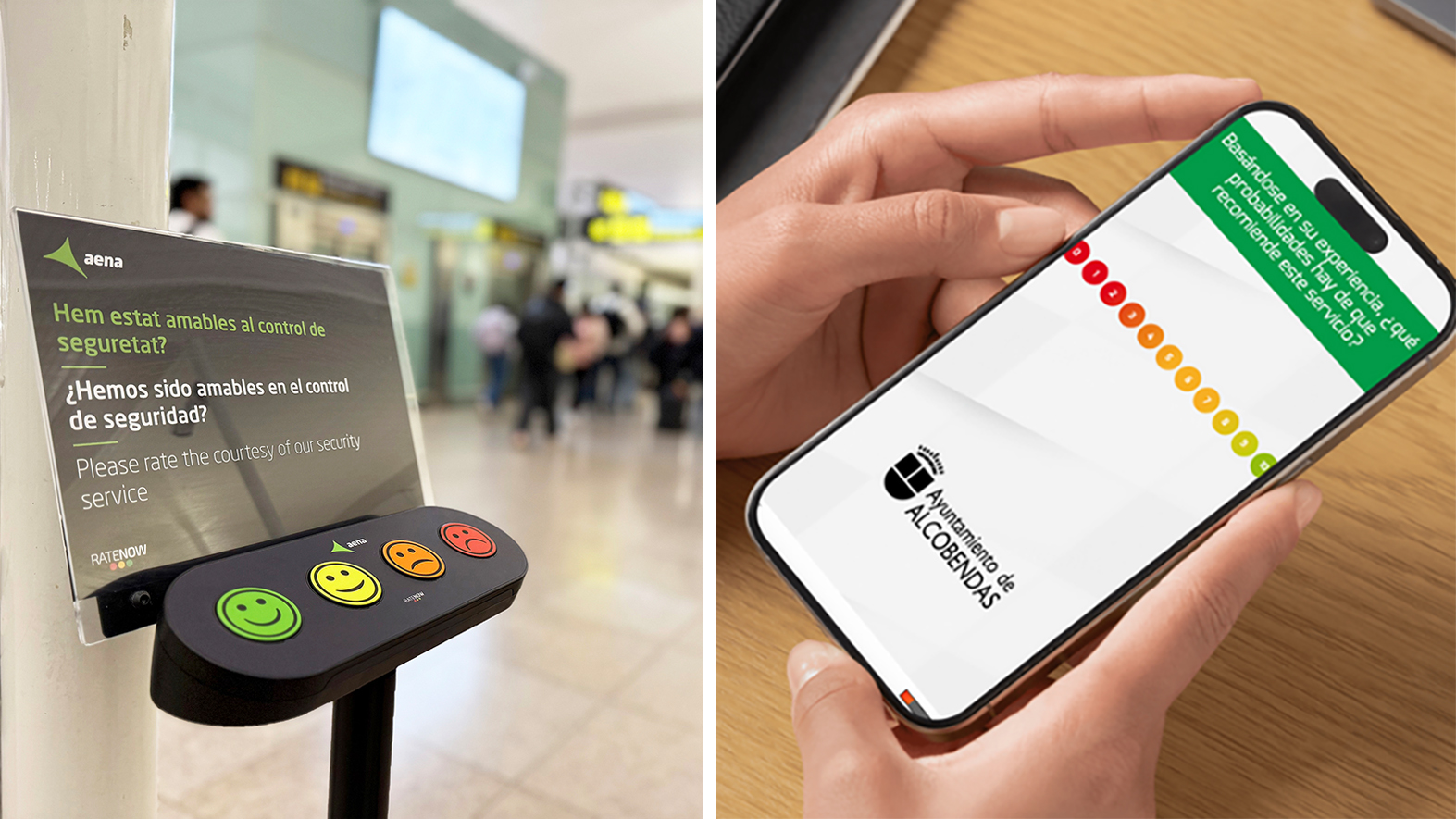
For every project, RateNow collaborates with public teams to map out the "citizen journey"—identifying touchpoints between the institution and the public to establish clear KPIs and gather empirical satisfaction data.
Implementation is not without challenges, particularly cross-departmental coordination and varying levels of municipal autonomy, Guillermo notes. "The main obstacles aren't technical; they come from public sector timelines and procedural hurdles," he explains. In smaller towns with outsourced IT support, for instance, coordination requires managing a three-way dynamic between the municipal council, RateNow, and the IT vendor.
Nevertheless, once operational, projects run smoothly and build long-term trust. Low-value direct contracts ("contratos menores", in Spanish) serve as an excellent entry point, he notes, "especially in year one, to test a solution." RateNow has also participated in over a hundred public tenders. While bureaucracy remains a challenge, it comes with a major upside: stability and long-term predictability. "Winning a tender can secure a project for three or four years if the service delivers." And for this digital SME, that has consistently been the case.
RateNow's Key Takeaways for Public Sector Scaling
- Focus on a universal need: Measuring user or citizen experience applies across virtually all public sectors.
- Clear, replicable product: Straightforward technology easily tailored to diverse administrative contexts.
- Co-creation with public teams: Jointly mapping out the citizen journey and defining key indicators.
- Patience with public sector cycles: Viewing administrative timelines as part of the learning curve.
- Sector-specific reputation: Leveraging word-of-mouth and institutional trust to drive expansion.
.jpg)